
If you are an NRI living in the USA and you earn any income from India, there is a good chance you need to file an income tax return in India this year. And no, your US tax filing does not cover it. These are two separate obligations, and mixing them up is one of the most common mistakes NRIs make.
The short answer first, because that is probably what you came for: an NRI must file an ITR in India for FY 2025-26 if their total taxable income in India crosses Rs 2.5 lakh (old regime) or Rs 3 lakh (new regime), or if they want to claim a TDS refund.
The deadline for most individual filers is 31 July 2026.
Now let us break down exactly how to do it, because the process has a few steps that trip people up, especially from outside India.
First, Confirm Your Residential Status
Everything depends on this. Your residential status under the Income Tax Act decides what income gets taxed in India.
You are an NRI for tax purposes if you spent less than 182 days in India during the financial year (April 2025 to March 2026). There is also a second condition involving 60 days plus 365 days over the past 4 years, but for most people settled in the USA on H1B, L1 or green card, the 182 day rule settles it.
One thing many people miss: if your Indian income is above Rs 15 lakh and you are not paying tax anywhere else, you might fall under the “deemed resident” rule. This mostly affects people who moved recently or split time between countries. If that sounds like you, count your days carefully before filing.
What Income Is Taxable in India for NRIs
As an NRI, only your India-sourced income is taxable in India. Your US salary is not taxed in India. Here is what typically counts:
- Rent from property in India
- Interest from NRO accounts (fully taxable, TDS of 30% applies)
- Capital gains from selling Indian shares, mutual funds or property
- Dividends from Indian companies
- Any salary earned for work done in India
- Business income from India
What is NOT taxable in India: interest on NRE and FCNR accounts, and your entire US income. This surprises a lot of first-time filers, in a good way.
Documents You Need Before You Start
Keep these ready, it saves a lot of back and forth:
- PAN card (mandatory, and it should be linked with Aadhaar if you have one)
- Passport with entry/exit stamps or travel history (to prove NRI status if asked)
- Indian bank account statements (NRO/NRE)
- Form 26AS and AIS (download from the income tax portal, shows all TDS deducted against your PAN)
- Rent agreements and tenant details if you have rental income
- Capital gains statements from your broker or mutual fund house (CAMS/KFintech can generate these)
- Home loan interest certificate if applicable
Step-by-Step: Filing Your ITR from the USA
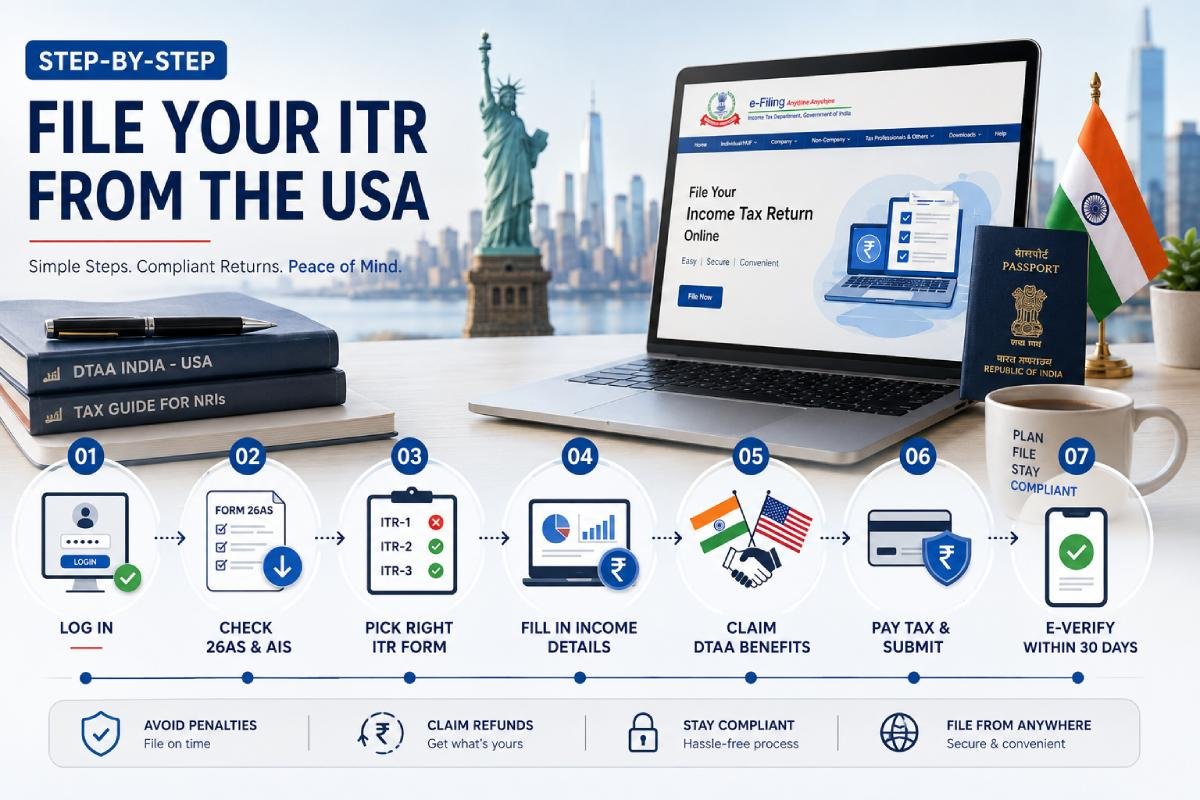
Step 1: Log in to the Income Tax Portal
Go to incometax.gov.in and log in with your PAN. If you never registered, registration takes about 10 minutes. You will need an Indian mobile number OR you can use your email for OTP as a non-resident. The portal now allows foreign mobile numbers for NRIs, which fixed a huge pain point from earlier years.
Step 2: Check Form 26AS and AIS
Before filing anything, download both. Form 26AS shows TDS deducted (your bank cuts 30% TDS on NRO interest, tenants may have cut TDS on rent). AIS shows almost every financial transaction linked to your PAN. If something in AIS looks wrong, you can submit feedback right there on the portal. Do not skip this step, mismatches between your return and AIS are the number one reason for notices.
Step 3: Pick the Right ITR Form
This is where NRIs commonly go wrong:
- ITR-2: For most NRIs. Covers salary, rent, capital gains, interest. If you sold mutual funds or stocks, this is your form.
- ITR-3: Only if you have business or professional income in India.
NRIs cannot use ITR-1 (Sahaj). Even if your only income is bank interest. Filing ITR-1 as an NRI makes your return defective.
Step 4: Fill In Your Income Details
The online utility pre-fills a lot from AIS now, but verify every number. Key sections for NRIs:
- Set your residential status as “Non-Resident” in the personal information tab
- Report NRO interest under “Income from Other Sources”
- Rental income goes under “Income from House Property” (you get a flat 30% standard deduction on it, plus home loan interest deduction)
- Capital gains need scrip-wise details for equity if you are claiming grandfathering, otherwise summary figures work
Also, you must report your foreign bank account details in the return if you are claiming a refund into a foreign account, though most NRIs just take refunds into their NRO account which is simpler.
Step 5: Claim DTAA Benefits (This Saves Real Money)
India and USA have a Double Taxation Avoidance Agreement. If the same income is taxed in both countries, you can claim credit. For income taxed in India, you will typically claim the Foreign Tax Credit on your US return (Form 1116) rather than in India. But if you paid US tax on income that India also taxes, you would file Form 67 on the Indian portal before filing your ITR to claim credit in India.
For most USA-based NRIs the flow is: pay tax in India on Indian income, then claim that as FTC in your US filing. Keep your Indian tax payment challans and ITR acknowledgment safe for your CPA.
To get DTAA benefits on TDS rates (like lower TDS on interest), you need a Tax Residency Certificate (TRC) from the IRS, which is Form 6166. You apply for it using Form 8802 and it takes 6 to 8 weeks, so plan ahead.
Step 6: Pay Any Balance Tax and Submit
If TDS already deducted covers your liability, great. If not, pay the balance as self-assessment tax through the portal (you can pay with an Indian bank account via net banking). Then submit the return.
Step 7: E-Verify Within 30 Days
Your return is not complete until you verify it. Options that work from the USA:
- Aadhaar OTP (if your Indian mobile is active on WhatsApp calling or roaming)
- Net banking of your Indian bank
- Sending a signed physical ITR-V to CPC Bengaluru by post (the slow, last-resort option)
Most NRIs use net banking e-verification, it takes 2 minutes.
Key Deadlines for FY 2025-26 (AY 2026-27)
| Task | Deadline |
|---|---|
| ITR filing (no audit) | 31 July 2026 |
| Belated/revised return | 31 December 2026 |
| Form 67 for FTC in India | Before filing ITR |
Miss the July deadline and you pay a late fee up to Rs 5,000, plus you lose the ability to carry forward certain losses. File early, the portal gets slow in the last week of July every single year.
Common Mistakes NRIs Should Avoid
- Filing ITR-1 instead of ITR-2 – makes the return defective
- Not reporting NRO interest – the bank already reported it via TDS, the tax department knows
- Ignoring small TDS refunds – 30% TDS on NRO interest is usually more than your actual liability, filing gets that money back
- Keeping a resident savings account after moving abroad – convert it to NRO, it is a FEMA requirement
- Forgetting Form 67 deadline when claiming foreign tax credit in India
Do You Even Need to File? Quick Checklist
File your Indian ITR if any of these apply:
- Indian income above the basic exemption limit
- TDS was deducted and you want a refund (very common with NRO accounts)
- You sold property, shares or mutual funds in India (even at a loss, filing helps carry it forward)
- You want clean financial records for future loans or repatriation
If your only Indian money is in an NRE account earning tax-free interest, and you have zero other Indian income, you generally do not need to file.
Frequently Asked Questions
Do NRIs in USA have to file taxes in India every year?
Only if your taxable Indian income crosses the exemption limit, or you want to claim a TDS refund, or you had capital gains transactions. There is no blanket requirement just because you hold a PAN.
Can I file my Indian ITR myself from the USA or do I need a CA?
If your income is just NRO interest and maybe rent, you can easily file yourself on the portal. If you have capital gains across multiple brokers, property sales, or DTAA credit claims, a CA who handles NRI cases is worth the Rs 3,000 to 8,000 fee.
Is my US salary taxable in India?
No. As an NRI, income earned and received outside India is not taxable in India. Only your India-sourced income is.
What happens if I never filed but had TDS deducted for years?
You have simply gifted that refund money to the government. You can still file for the current year and set things right going forward. For older years, refund claims are mostly time-barred, though condonation requests are possible in genuine cases.
Do I need to report my Indian income on my US tax return too?
Yes. The USA taxes citizens and residents on worldwide income, so your Indian rent, interest and capital gains go on your US return as well. You then claim Foreign Tax Credit for taxes paid in India to avoid double taxation. Also remember FBAR (FinCEN 114) if your Indian accounts crossed $10,000 combined at any point in the year.